
20 Nov 2026
Faster, Smarter Climate Forecasting: How MIT’s New AI Technique Is Transforming Environmental Modeling.
By Diwakar Chandra Gour
Faster, Smarter Climate Forecasting: How MIT’s New AI Technique Is Transforming Environmental Modeling.
Accurate, up-to-date climate projections are critical for making real-world decisions—from strengthening power grid resilience and planning clean energy transitions to safeguarding public health and maximizing agricultural yields. Yet for decades, climate science has faced a stubborn computational bottleneck.
Full-scale Earth System Models (ESMs) capture the complex physics of our atmosphere, oceans, and land in extraordinary detail, but simulating even a single future climate scenario can take weeks or months on massive supercomputing clusters. To bridge that gap, researchers rely on lightweight machine learning tools called climate emulators, which can generate projections in seconds.
Now, researchers at the Massachusetts Institute of Technology (MIT) have unveiled a breakthrough training methodology—published in the Proceedings of the National Academy of Sciences (PNAS)—that dramatically cuts the time and computing cost required to build faster, more reliable, and adaptable AI climate emulators.
Overcoming the Climate Emulator Bottleneck.
Until now, building an accurate AI climate emulator came with two major challenges:
Prohibitive Training Costs: Conventional emulators typically require six to eight full supercomputer simulations of plausible future emissions scenarios just to generate enough training data. Because each full ESM run takes months, climate emulators are often outdated before they even reach researchers and policymakers.
Poor Generalization to Unfamiliar Scenarios: MIT researchers discovered that training AI emulators exclusively on smooth, realistic emissions pathways (such as standard Shared Socioeconomic Pathways) leaves them fragile. When asked to predict conditions outside their training set—such as abrupt policy shifts or localized pollution controls—traditional emulators frequently struggle.
How MIT’s Synthetic Training Technique Works.
Led by MIT PhD graduate Christopher Womack and senior author Professor Noelle E. Selin (alongside collaborators across MIT’s Department of Earth, Atmospheric and Planetary Sciences and the Institute for Data, Systems, and Society), the team flipped conventional AI training on its head:
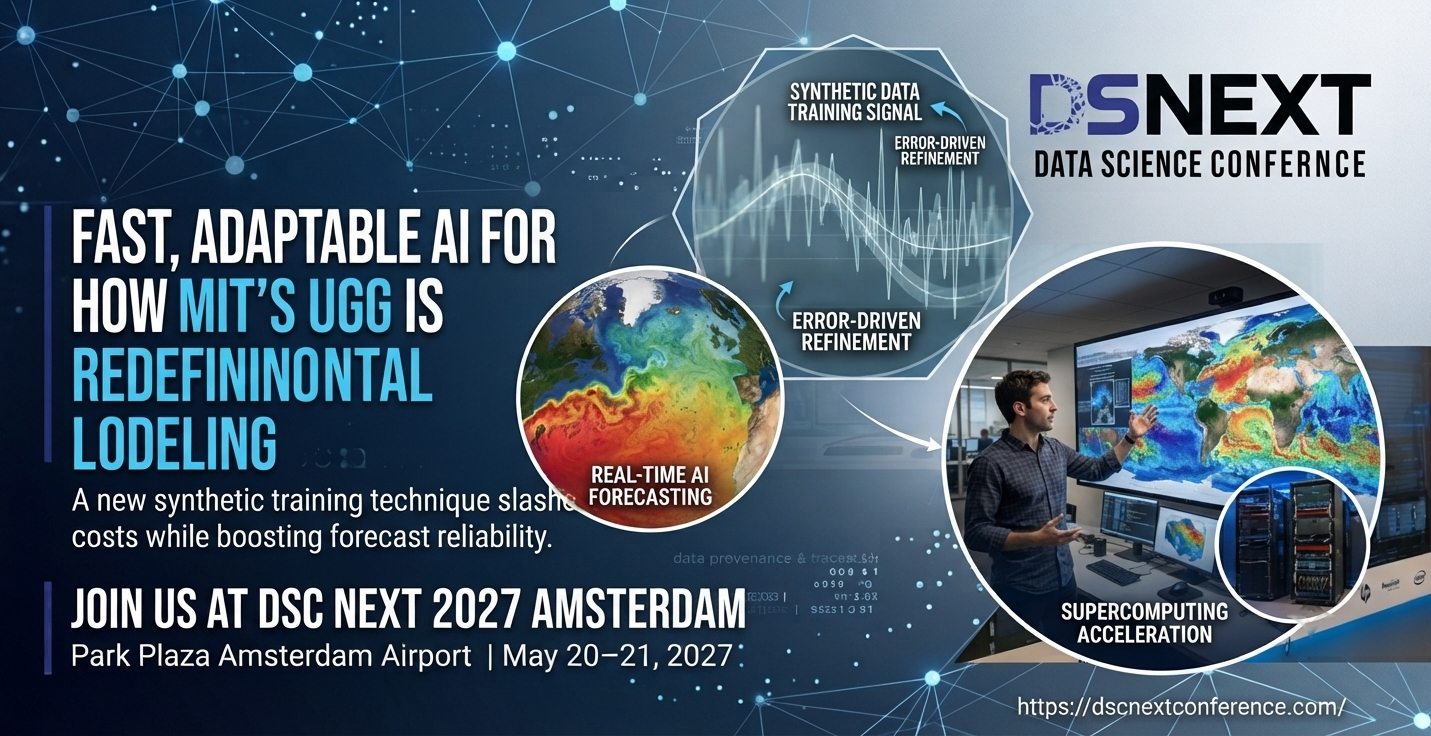
One Supercomputer Run Instead of Eight: Rather than generating multiple expensive ESM simulations, the new technique requires only a single full climate model run—slashing supercomputing time and cost by up to 85%.
Iterative Error-Driven Optimization: The algorithm starts with an arbitrary scenario from a fast, simple climate model, compares the AI emulator’s output against the full ESM result, and iteratively refines the training dataset wherever prediction errors appear.
High-Frequency Synthetic Signals: Instead of smooth curves, the resulting synthetic training data contains rapid, unconventional oscillations—such as sharp spikes in carbon dioxide or sudden drops in methane. Those sharp variations teach the AI far richer physical relationships across the climate system, enabling it to accurately simulate regional interventions and unseen scenarios that older emulators fail to capture.
Why This Matters for Data Science, Energy, and Policy
This breakthrough highlights a powerful lesson for the entire data science community: smarter training data design can outperform brute-force compute. By pairing domain physics with iterative synthetic data generation, MIT’s approach unlocks immediate real-world impact:
Agile Energy and Grid Planning: Utilities and energy planners can rapidly stress-test thousands of regional climate scenarios to prepare infrastructure for extreme weather and shifting renewable generation patterns.
Precision Environmental Policy: Policymakers can evaluate the localized impacts of targeting specific pollutants—such as cutting methane or regional aerosols while other emissions vary—without waiting months for supercomputer results.
Broader Scientific AI Applications: Beyond climate modeling, this error-driven synthetic training framework holds strong potential for complex physical simulations, scientific machine learning, and computer vision workflows where high-fidelity training data is scarce or expensive.
Join the Conversation at DSC Next 2027 Amsterdam
From physics-informed AI and synthetic data engineering to sustainable high-performance computing, data science is accelerating solutions to the world’s most urgent environmental and industrial challenges.
Join global data scientists, AI researchers, and enterprise technology leaders at DSC Next 2027 (3rd Edition) to explore the methodologies, models, and real-world breakthroughs shaping the future of data-driven decision making:
Dates: May 20–21, 2027
Location: Park Plaza Amsterdam Airport, Amsterdam, Netherlands
Official Website: https://dscnextconference.com/
What to Expect: World-class keynotes, technical deep-dives into scientific AI, sustainable computing, and predictive modeling, multidisciplinary panel debates, and premier international networking.
Explore the conference tracks and secure your pass today at https://dscnextconference.com/.